
The Forensic Role of UV Light in Cold Case Identification
Introduction
Unidentified human remains—often referred to as “Jane Doe” or “John Doe”—carry with them a profound emotional weight for families and communities. While DNA profiling and dental comparisons are the gold standards in modern forensic identification, ultraviolet (UV) light offers a uniquely non‑destructive way to reveal trace evidence that might otherwise be lost to time.
How UV‑A Light Illuminates Hidden Clues
Specialized forensic lamps emitting UV‑A (320–400 nm) can make invisible details fluoresce, giving investigators fresh leads when cases have gone cold:
- Biological Fluids: Tiny residues of semen, saliva, urine or sweat will glow under UV‑A, guiding precise sample collection.
- Skeletal & Tissue Fragments: Small bone or soft‑tissue remnants buried in soil or debris become more conspicuous when illuminated.
- Decomposition & Insect Activity: Early stages of tissue breakdown and insect colonization alter fluorescence patterns, helping refine post‑mortem interval estimates.
- Latent Fingerprints & Trauma Marks: Bruising, bite marks or faint fingerprints on clothing or skin can suddenly appear under the correct UV‑A wavelength.
Tools of the Trade: Spectro‑UV Forensic Lights
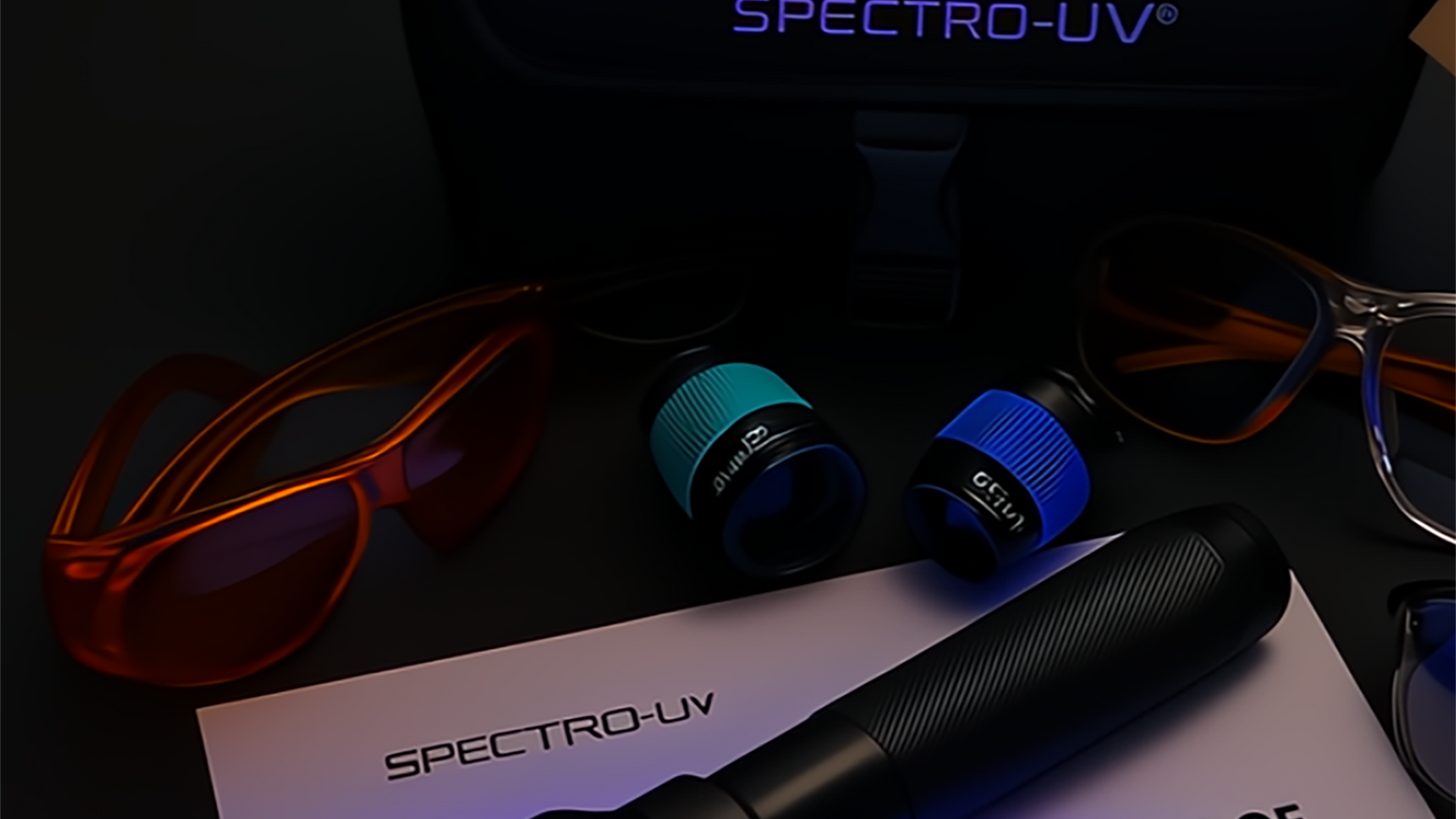
Portability, consistency and intensity are crucial in the field. Spectro‑UV’s purpose‑built forensic flashlights deliver all three, empowering teams to work confidently both in the lab and on‑site:
- Nano Series IDX‑500 UV Flashlight: A compact handheld flashlight peaking at 365 nm ± 10 nm, delivering approximately 33,000 µW/cm² at 15″ (38 cm). Rechargeable Li‑Ion power ensures up to 3 hours of continuous use—ideal for rapid scans of crime‑scene areas.
- OPTI‑LUX™ 365 nm UV‑A Inspection Flashlight Kit (OLX‑365): With a peak output of 365 nm ± 5 nm and around 10,000 µW/cm² at 15″, this anodized aluminum flashlight offers a 4‑hour runtime on a 3.7 V Li‑Ion battery. Its spare filter slot lets you switch between orange and clear filters for enhanced contrast.
- OPTIMAX™ Multi‑Lite™ LED Forensic Field Kit (OFK‑500A): Featuring three interchangeable LED heads—UV‑A (365 nm, 310 mW), Blue (450 nm, 480 mW) and Cyan (500 nm, 100 lm)—this kit uses a 3.6 V, 2 Ah NiMH battery for 90 minutes of runtime. An Electronic Intensity Stabilizer and domed lens provide a uniform beam, while included UV‑absorbing spectacles protect the user’s eyes.
From Evidence to Closure
No single tool closes a cold case—but UV‑A illumination often acts as the spark that reignites an investigation. By uncovering hidden stains, locating minute fragments and revealing trauma marks, these lights bridge the gap between overlooked evidence and renewed investigative momentum. Each reveal under UV‑A brings families one step closer to answers—and to restoring the humanity behind every “Jane” and “John Doe.”
Conclusion
Every unidentified person was once someone’s beloved family member or friend. Through precise, reliable UV‑A inspection tools—like the IDX‑500, OLX‑365 and OFK‑500A—investigators can shine a light on the past, offering dignity to the unidentified and hope to those who wait for closure.
Real‑World Impact & Supporting Studies
· Portable Multimodal Light Source
A 2022 Scientific Reports study described a handheld device integrating UV‑A, blue, and white LEDs for one‑click visualization of latent evidence, underscoring the value of battery‑powered LED sources in field recovery operations Nature.
· Body Fluid Identification Review
A 2021 review in PMC 8617621 highlights UV‑A imaging as a rapid, non‑invasive screening step that directs targeted sampling for DNA or immunoassay confirmation PMC.


Оставить комментарий
Этот веб-сайт защищается hCaptcha. Применяются Политика конфиденциальности и Условия использования hCaptcha.