

In the oil and gas industry, the consequences of a missed defect are measured in catastrophic failures, environmental disasters, and human lives. Pipelines operating under thousands of PSI, pressure vessels exposed to corrosive hydrocarbons, and offshore platform welds subjected to cyclic fatigue loading, all demand inspection methods that catch what the naked eye cannot. UV-A fluorescent non-destructive testing (NDT) is one of the most trusted tools for doing exactly that.
Why UV-A inspection matters in oil and gas
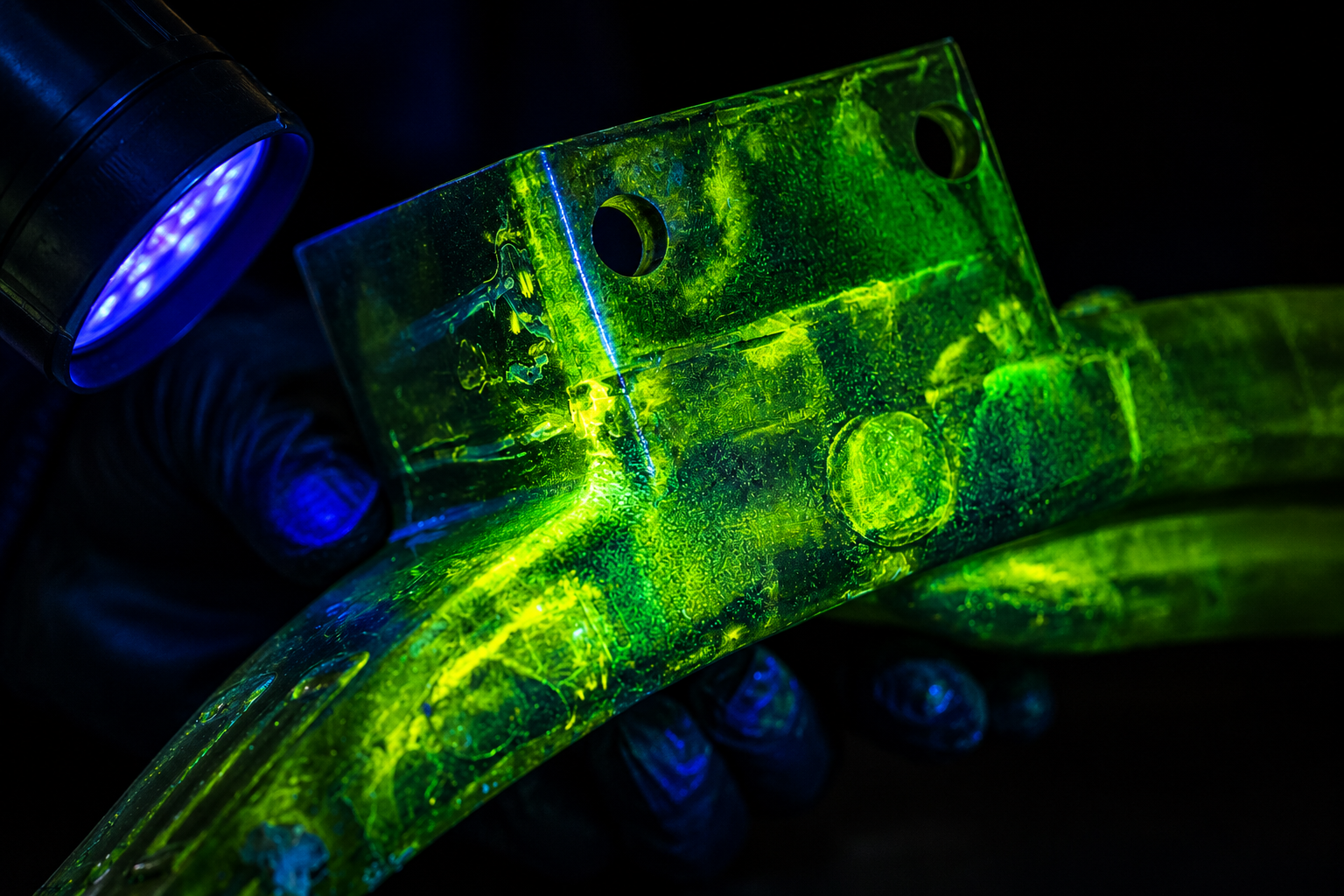
Fluorescent magnetic particle inspection (FMPI) and fluorescent liquid penetrant inspection (FLPI) are surface and near-surface defect detection methods used extensively across upstream, midstream, and downstream oil and gas operations. Both methods use UV-A light at 365 nm to excite fluorescent dyes or magnetic particles that have settled into cracks, seams, and discontinuities; making invisible defects glow visibly under blacklight conditions.
The method is favored in oil and gas for several practical reasons. It is highly sensitive to the tight fatigue cracks and stress corrosion cracking that are prevalent in pipelines and pressure-bearing equipment. It requires no radiation, no complex interpretation software, and can be executed in the field with portable equipment. And it leaves no residual damage to the component being tested.
Where UV-A fluorescent inspection is applied in oil and gas
Pipeline weld inspection
Weld integrity is the most common application. Every girth weld on a pipeline - whether onshore or subsea - is a potential failure point. FMPI and FLPI are used to verify weld quality during fabrication, after hydrostatic testing, and during in-service maintenance. Inspectors in pipeline ditches and on drill rigs rely on portable, battery-powered UV-A lamps capable of delivering compliant irradiance in tight, low-access environments.
Pressure vessel and heat exchanger inspection
Refinery pressure vessels, storage tanks, and heat exchangers undergo periodic inspection per API 510 (Pressure Vessel Inspection Code) and API 570 (Piping Inspection Code). Fluorescent penetrant inspection is routinely specified for nozzle welds, shell seams, and internal surfaces where stress corrosion cracking and hydrogen-induced cracking are primary concerns.
Offshore platform and subsea structure inspection
Structural welds on offshore platforms and jacket structures are subject to API RP 2X and AWS D1.1 weld inspection requirements. UV-A fluorescent inspection is used at fabrication yards and during in-service inspections to assess weld quality on structural members, risers, and topside equipment. The marine environment makes lamp durability and moisture resistance critical selection factors.
Valve, fitting, and rotating equipment inspection
High-pressure valves, flanges, compressor components, and pump casings are inspected for surface cracking before installation and during scheduled turnarounds. In rotating equipment, fatigue cracking at shaft fillets and keyways is a known failure mode that FMPI detects reliably at sub-surface depths.
The portability of modern LED UV-A lamps has significantly expanded where fluorescent inspection can be performed, from fabrication bays to pipeline rights-of-way to confined vessel interiors, all without sacrificing compliant irradiance output.
UV-A lamp requirements for oil and gas NDT
Not every UV-A lamp is appropriate for regulated oil and gas inspection work. The governing standard for LED UV-A lamps in fluorescent NDT is ASTM E3022 (currently ASTM E3022-26a, the active revision as of 2026). The standard requires lamps to deliver a minimum of 1,000 µW/cm² UV-A irradiance at 15 inches (38 cm) from the inspection surface, with visible light emission capped at 2 foot-candles. Exceeding the minimum is strongly preferred; higher irradiance shortens inspection time and improves indication contrast, particularly when working in partially darkened field conditions rather than dedicated inspection booths.
Many major oil and gas operators and EPCs also specify ASTM E2297 compliance for the measurement instruments used to verify lamp output, requiring periodic radiometric verification with calibrated UV meters as part of inspection procedure qualification. Lamp output degrades over time and a lamp that was compliant at purchase may fall below threshold without the operator knowing, which is why documented recalibration intervals are an essential part of any UV NDT program.
Handheld vs. overhead UV-A lamps in field conditions
Oil and gas inspection environments vary from climate-controlled fabrication shops to open-cut pipeline ditches to confined spaces inside pressure vessels. The lamp selection should match the working environment. Handheld LED UV-A lamps offer portability and flexibility for weld-by-weld inspection in the field. Overhead UV-A flood systems are better suited for fabrication bays and inspection stations where large surface areas need consistent, uniform irradiance coverage. Battery-powered models eliminate the need for power cables in remote pipeline locations, while corded models are appropriate for stationary inspection booths and fabrication lines.
Selecting a compliant UV-A lamp for oil and gas work
When evaluating UV-A lamps for oil and gas inspection programs, verify the following before purchase or specifying in a procedure: documented ASTM E3022 compliance at the stated working distance; UV-A output well above the 1,000 µW/cm² minimum (lamps delivering 4,000–5,000 µW/cm² at 15 inches provide meaningful margin); low visible light emission that will not compete with fluorescent indications; and a lamp design suited to the physical demands of oil and gas environments; including resistance to drops, penetrant contamination, and temperature extremes. Confirm that your radiometer is calibrated and that recalibration intervals are documented in your inspection procedure.
Spectro-UV offers a full range of ASTM E3022-compliant UV-A lamps: handheld, battery-powered, and overhead, built for the demands of oil and gas NDT. All lamps are manufactured, tested, and calibrated at our ISO/IEC 17025-accredited Long Island facility.

留言
此網站已受到 hCaptcha 保護,且適用 hCaptcha 隱私政策以及服務條款。