
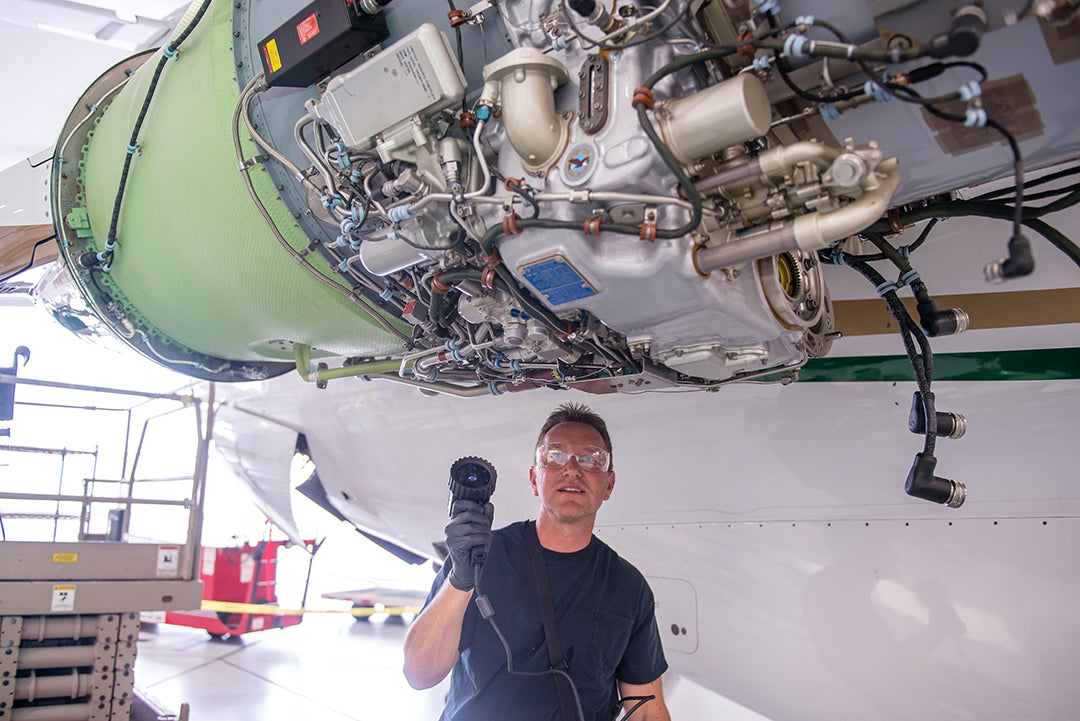
Best UV-A Lamps for Aerospace Inspection Compliant with ASTM E3022, Rolls-Royce, Airbus and Pratt & Whitney Standards
Aircraft safety depends on detecting microscopic cracks, fatigue fractures, and surface flaws before they lead to failure. That is why aerospace manufacturers and MRO (maintenance, repair, and overhaul) facilities rely on UV-A fluorescent inspection lamps for non-destructive testing (NDT).
However, not all UV-A inspection lamps are suitable for aerospace use. To ensure reliable detection performance, many facilities require lamps that meet ASTM E3022 and, depending on their engine programs, Rolls-Royce RRES 90061, Airbus AITM6-1001 or Pratt & Whitney compliance standards.
Choosing a compliant UV-A lamp is not just best practice. It is essential for quality assurance, audit readiness, and inspection confidence.
What is UV-A Inspection in Aerospace?
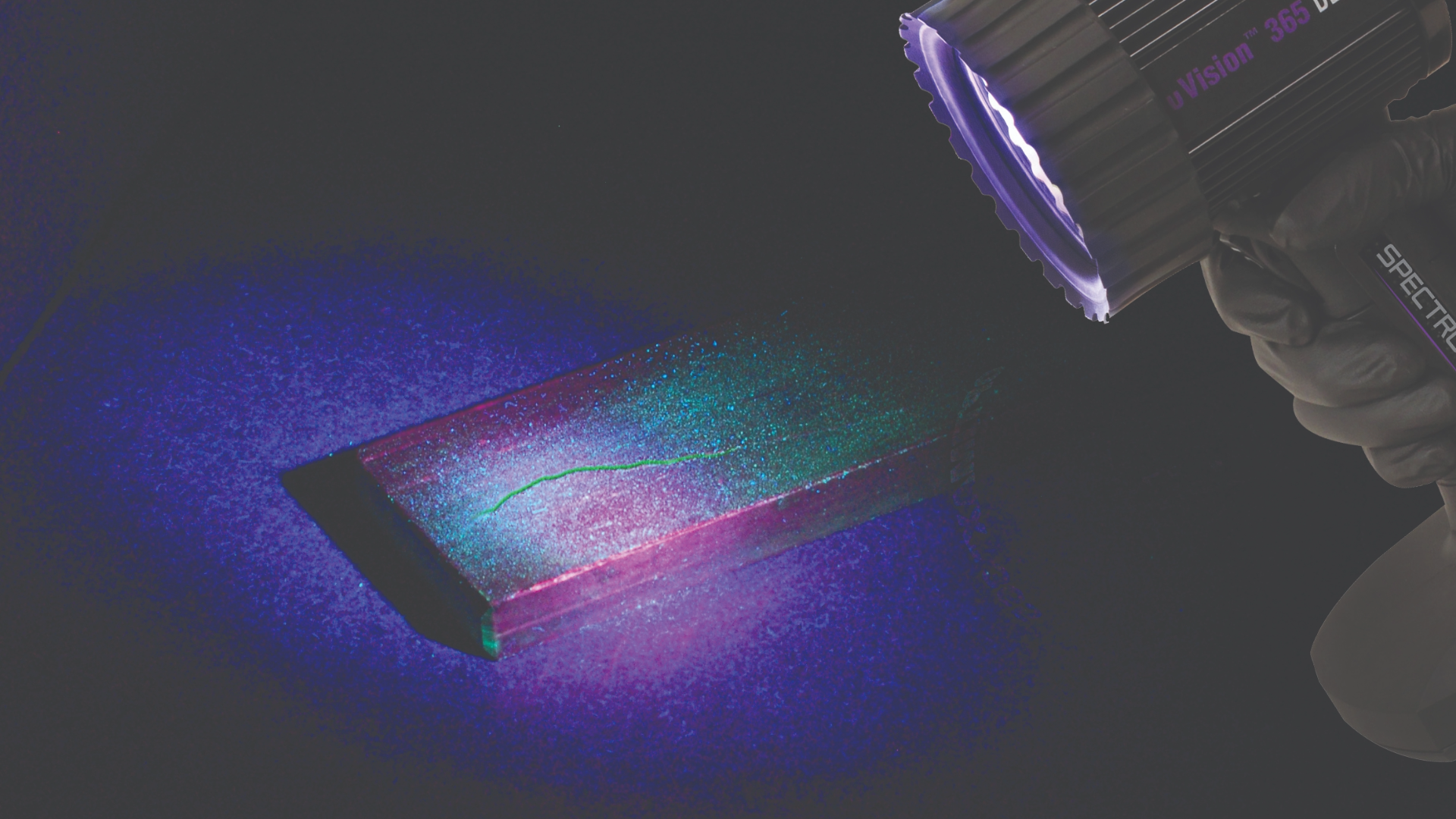
UV-A fluorescent inspection is widely used across aerospace manufacturing and maintenance operations to detect cracks, leaks, weld flaws, and material defects without damaging the component.
The two primary methods: fluorescent magnetic particle inspection (FMPI) and fluorescent liquid penetrant inspection (FLPI), rely on UV-A light (peak wavelength 365nm) to excite fluorescent dyes that have settled into defects, making them glow visibly under blacklight.
These methods are widely mandated across commercial aviation, military aircraft, and aerospace engine manufacturing because they are sensitive, repeatable, and leave no permanent mark on the component being tested.
Four key standards govern UV-A lamp performance in aerospace NDT: ASTM E3022 , Rolls-Royce RRES 90061, Airbus AITM6-1001 and Pratt & Whitney compliance requirements.
Why ASTM E3022 Compliance Matters
Published by ASTM International, E3022 defines the minimum UV-A irradiance, visible light emission limits, and measurement requirements for lamps used in fluorescent NDT. It requires lamps to produce a minimum of 1,000 µW/cm² at 15 inches (38 cm) and caps visible (white) light at 2 foot-candles. These thresholds ensure that fluorescent indications are sufficiently excited and that ambient light does not wash them out.
What is Rolls-Royce RRES 90061?
Rolls-Royce's proprietary specification RRES 90061 imposes more stringent requirements for suppliers and MRO facilities working on Rolls-Royce engines. It builds on the ASTM foundation, adding additional performance benchmarks and documentation requirements, meaning facilities that service Rolls-Royce engines must use lamps that are verified compliant, not merely assumed to be.
What is Airbus AITM6-1001?
Airbus AITM6-1001 is Airbus’s internal test method specification covering fluorescent penetrant and magnetic particle inspection procedures used across its commercial aircraft programs. Facilities performing NDT on Airbus components are required to use equipment that conforms to AITM6-1001, which defines performance criteria for UV-A lamps including irradiance levels, visible light limits and measurement procedures consistent with Airbus quality standards.
What is Pratt & Whitney Compliance?
Pratt & Whitney maintains its own supplier and MRO qualification requirements for NDT equipment used on its commercial and military engine programs. UV-A lamps used in Pratt & Whitney-approved facilities must meet performance standards aligned with their quality management system, ensuring consistent defect detection across all inspection operations. Facilities performing inspections on Pratt & Whitney engines must verify that their UV-A lamps meet these requirements as part of their approved supplier qualifications.
Using a non-compliant lamp in either environment is not just a regulatory violation; it introduces real risk that a defect will go undetected.
LED vs. Traditional UV-A lamps in Aerospace NDT
The aerospace industry has largely migrated from traditional mercury vapor (HID) UV-A lamps to LED-based systems. LED lamps reach full intensity instantly, require no warm-up period, produce less heat, and maintain more consistent output over their lifespan. For compliance purposes, LED lamps can meet and exceed both ASTM E3022, RRES 90061, AITM6-1001 and Pratt & Whitney thresholds, provided they are properly engineered and tested. Not all LED UV lamps on the market are created equal, and several do not meet aerospace compliance requirements out of the box.
How to Choose a Compliant UV-A lamp for Aerospace NDT
When selecting a UV-A lamp for aerospace inspection, verify the following before purchasing:
Compliance
- · ASTM E3022 tested
- · RRES 90061 qualified if servicing Rolls-Royce engines
- · Airbus AITM6-1001 compliant if working on Airbus programs
- · Pratt & Whitney compliant if supporting Pratt & Whitney engine programs
Performance
- · Strong UV-A intensity at working distance
- · Low visible light contamination
- · Uniform beam coverage
Reliability
- · Stable long-term output
- · Rugged industrial construction
- · Rechargeable or continuous-use options
Quality Control Support
- · Compatible with calibrated UV radiometers
- · Service and recalibration availability
Why Professionals Choose Spectro-UV Lamps
Spectro-UV supplies aerospace-compliant UV-A inspection lamps trusted by manufacturers, MRO facilities, and NDT professionals worldwide. Whether your application calls for portability in the field or high-intensity coverage on a production line, there is a compliant solution in our lineup.
Frequently Asked Questions
What UV wavelength is used in aerospace inspection?
Most aerospace fluorescent inspection uses 365 nm UV-A light
What is the minimum UV intensity for ASTM E3022?
Typically 1,000 µW/cm² at 15 inches.
Can LED UV lamps meet aerospace standards?
Yes, when properly engineered, tested and documented
Do Spectro-UV lamps meet Airbus AITM6-1001 requirements?
Yes. Spectro-UV lamps are compliant with Airbus AITM6-1001, making them suitable for use in Airbus-approved manufacturing and MRO operations.
Are Spectro-UV lamps suitable for Pratt & Whitney-approved facilities?
Yes. Spectro-UV lamps meet Pratt & Whitney compliance requirements for UV-A NDT inspection equipment.

留言
此網站已受到 hCaptcha 保護,且適用 hCaptcha 隱私政策以及服務條款。