
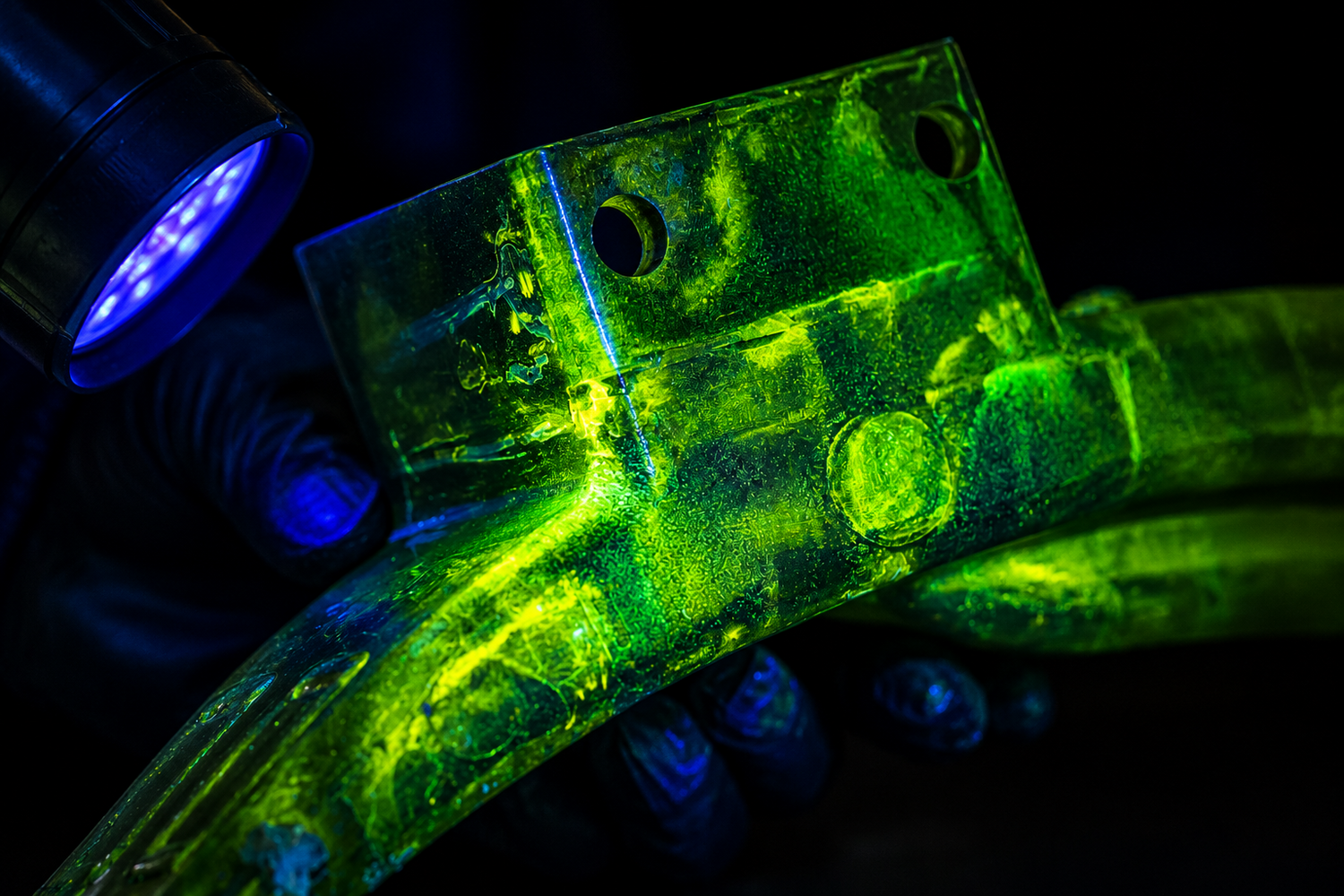
A practical guide to UV-A intensity thresholds across NDT, forensic, and life-science inspection work and why the number on your radiometer matters more than the number on your lamp.
Why µW/cm² Is the Number That Actually Matters
Every UV inspection process, whether it's fluorescent penetrant testing on a turbine blade, an alternate light source sweep at a crime scene, or a curing check in a lab, depends on one shared variable: how much ultraviolet energy is reaching the surface being examined. That's measured in microwatts per square centimeter (µW/cm²), and it's the figure inspectors, auditors, and quality managers care about far more than a lamp's wattage or bulb type.
Wattage tells you how much power a lamp draws. Intensity at the surface tells you whether your inspection is valid. The two are related, but they are not the same thing: lamp age, bulb type, filter condition, standoff distance, and even ambient temperature all affect the number that lands on the part. That's why every serious standard specifies a minimum µW/cm² at a defined distance, not a bulb spec.
Fluorescent Penetrant and Magnetic Particle Inspection (NDT)
In aerospace, automotive, and general industrial NDT, UV-A intensity requirements are the backbone of a defensible inspection. ASTM E3022 and the legacy ASTM E1417/E1444 series set the benchmark most U.S. shops work to, while ISO 3059 governs much of the international and European supply chain. Airbus AITM6 and Pratt & Whitney specs layer additional OEM-specific requirements on top.
The commonly cited baseline: a minimum of 1,000 µW/cm² of UV-A intensity at the inspection surface, typically verified at a 15-inch (38 cm) standoff distance, alongside a maximum visible light level (often 2 foot-candles) to preserve fluorescent contrast. Some OEM specs push the minimum higher; it is important to always check the governing procedure before assuming the general standard applies.
• Fluorescent penetrant inspection (FPI): verifies indications of fluoresce clearly against a darkened background.
• Magnetic particle inspection (MPI) with fluorescent media: same intensity floor but also depends on field strength and particle concentration.
• Standoff distance changes everything: intensity falls roughly with the square of distance, so a lamp verified at 15 inches will read very differently at 20.
Forensic and Alternate Light Source (ALS) Work
Forensic UV work operates differently. Instead of chasing a single fixed threshold, examiners typically need a controllable, repeatable intensity across a range of UV and visible wavelengths, since different evidence types (biological fluids, fibers, latent prints, questioned documents) fluoresce best under different combinations of wavelength and intensity.
Rather than a pass/fail µW/cm² minimum, forensic protocols usually call for documenting the exact wavelength and intensity setting used to develop each piece of evidence, so the finding can be reproduced later in court or by an independent examiner. Consistency and documentation matter as much as raw output here.
Life Sciences and Laboratory Applications
In life sciences, verification, authentication and general lab UV work, intensity requirements are typically driven by the specific assay, reagent, or material being examined rather than a single cross-industry standard. A radiometer reading is still the reference point, but the target µW/cm² comes from the protocol or reagent manufacturer, not a blanket NDT-style spec.
The common thread across all three fields: whatever the target number is, it must be measured at the surface, under the actual working conditions, with a calibrated radiometer, not assumed from the lamp's rated output.
Typical Intensity Reference Points
|
Application |
Typical Reference |
Key Variable |
|
FPI / MPI (NDT) |
≥ 1,000 µW/cm² UV-A @ 15" |
Standoff distance, lamp age |
|
Forensic ALS |
Set per evidence type; documented, not fixed |
Wavelength selection |
|
Life sciences / lab |
Per assay or reagent protocol |
Application-specific target |
General industry reference points; always confirm against the governing standard, OEM spec, or protocol for your specific application.
Why Radiometer Verification Isn't Optional
UV lamps degrade. Mercury vapor bulbs lose output as they age; LED arrays drift with temperature and hours of use; filters haze over. A lamp that met spec on day one can silently fall below the required µW/cm² months later, and the inspection log will show nothing wrong unless someone measures it.
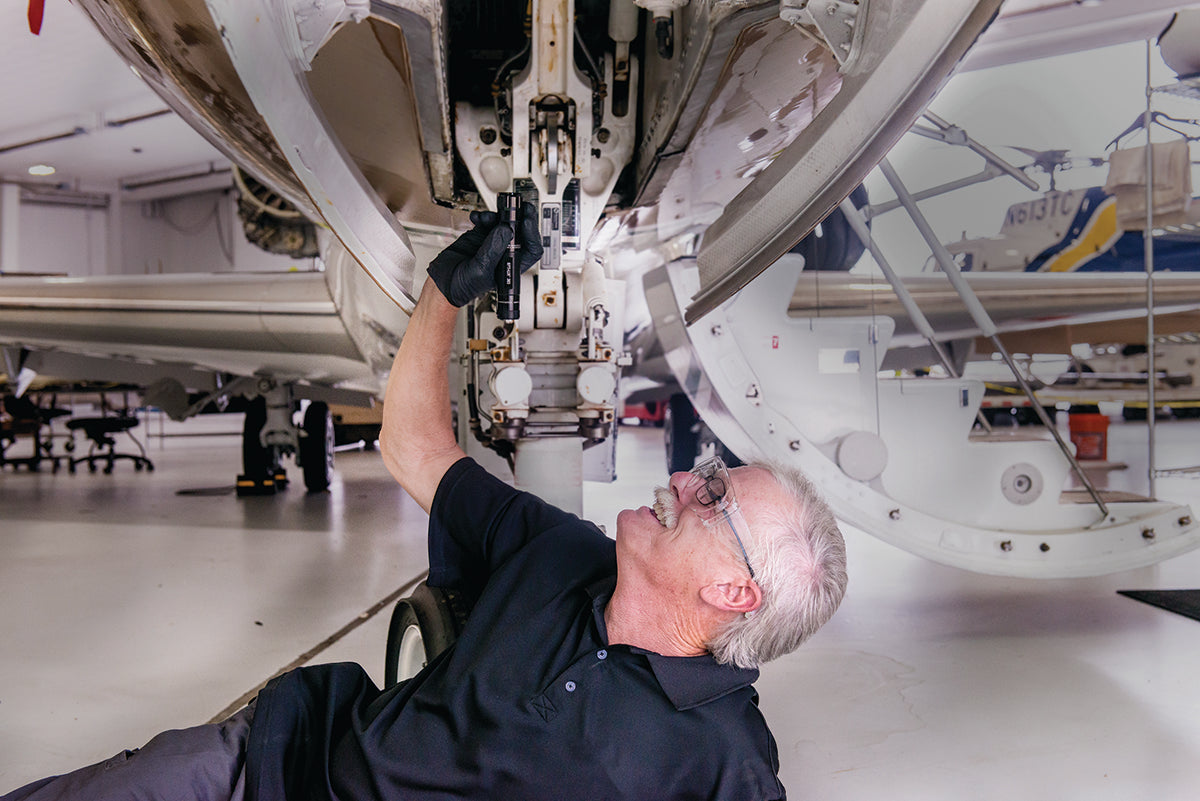
• Verify intensity at the actual working distance, not just at the lamp face.
• Recalibrate or replace radiometers on a documented schedule; a drifting meter is as risky as a drifting lamp.
• Log readings alongside each inspection shift, not just at annual audit time.
This is where the right equipment pairing matters: a UV source with stable, well-characterized output, paired with a properly calibrated radiometer, turns intensity compliance from a periodic scramble into a routine five-second check.
The Takeaway
µW/cm² isn't a spec-sheet formality; it's the number that determines whether a defect gets caught, whether evidence holds up, or whether a lab result is trustworthy. Understanding what your process actually requires, at what distance, and how to verify it consistently is the difference between a compliant inspection and a costly miss.
Spectro-UV builds UV-A inspection lamps and radiometers designed around exactly this principle: stable, verifiable output you can document with confidence, starting the moment you turn the lamp on.
The Right Equipment for Every Intensity Requirement
Whichever threshold your process is chasing, Spectro-UV has a source-and-verification pairing built for it:
For NDT (FPI/MPI, ASTM E3022, ISO 3059, Rolls Royce RRES 90061, Airbus AITM6, Pratt & Whitney): The uVision™ and uVision™ MAX UV-A inspection lamps deliver stable, consistent output built to hold well above the 1,000 µW/cm² baseline at standard standoff distances, so you are not chasing a moving target as bulbs age. Pair them with AccuMAX™, AccuELITE™ or AccuPRO™ radiometers for calibrated, documented intensity readings at the actual inspection surface which is valuable for an auditor to see in the log.
For forensic and alternate light source work: Clarity™ 365 is built for the reality of ALS work: dual power options and a 9-hour runtime mean you can document wavelength and intensity settings consistently across a full scene, not just a lab bench. Its IP68 rating holds up in field conditions that forensic examiners work in.
For life sciences and lab applications: The Spectrolinker XL-1000/XL-1500 and X-Series UV crosslinkers give you the repeatable, protocol-matched output that assay and reagent-driven work demands, and the CM Fluorescence Cabinet provides a controlled environment for consistent fluorescence verification.
Whatever your intensity requirement, the pattern is the same: a well-characterized UV source, verified with a calibrated radiometer, at the distance your process specifies. Browse Spectro-UV’s full inspection and radiometer lineup to find the right pairing for your standard.

Laat een reactie achter
Deze site wordt beschermd door hCaptcha en het privacybeleid en de servicevoorwaarden van hCaptcha zijn van toepassing.