
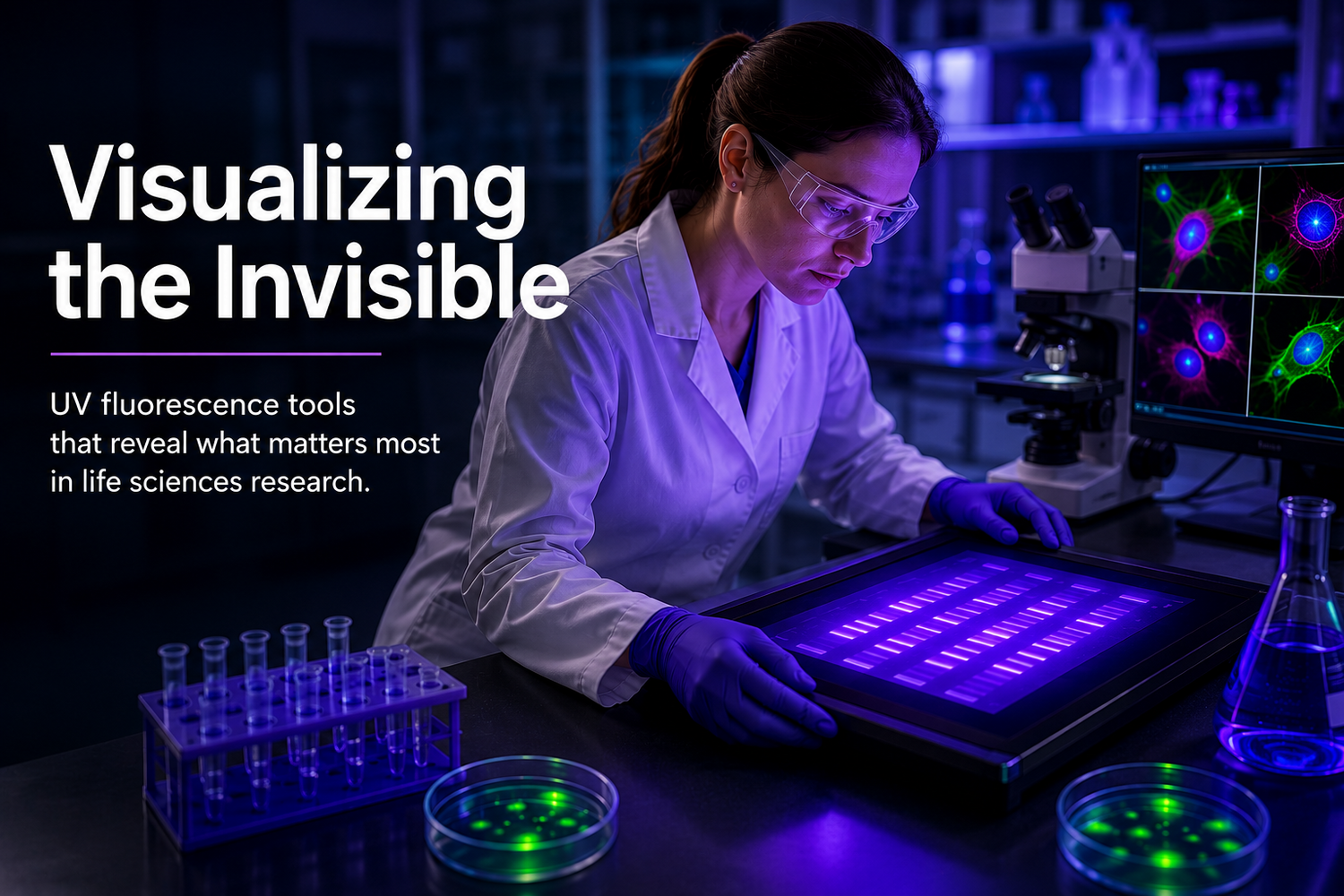
In a life sciences lab, some of the most critical details are invisible to the naked eye: bands on an agarose gel, residual contamination on a shared bench, a poorly bound membrane that could compromise an overnight blot, or fluorescent tags marking proteins you have spent weeks isolating.
UV light makes the invisible visible, but only if you are using the right tool for the right application. Not all UV instruments are created equal, and choosing the wrong one can lead to missed results, wasted samples, or worse, inconsistent data that is hard to reproduce.
Here is a practical breakdown of the most commonly used UV fluorescence tools in life sciences research, what each does best, and how to choose among them.
UV Crosslinkers: Precision Dosing for Molecular Biology Workflows
If your lab runs blot-based assays, UV crosslinkers are non-negotiable. Southern, Northern, and Western blotting all rely on covalently binding nucleic acids to nylon or nitrocellulose membranes and getting that binding right depends entirely on delivering the correct UV dose.
Too little UV energy and your DNA or RNA will wash off the membrane during hybridization. Too much and you will damage the nucleic acids, reducing signal sensitivity. The difference between a clean, publication-ready result and a blot you must run twice often comes down to dose accuracy.
Beyond blotting, UV crosslinkers are used for:
- DNA/RNA fixation to membranes for hybridization experiments and gene expression studies
- Protein–nucleic acid crosslinking (CLIP assays, ChIP workflows) to capture binding events in live cells
- PCR contamination control: UV-treating workspaces and consumables to eliminate carryover DNA
- Decontaminating pipettes, tubes, and small equipment between experiments
Look for instruments with programmable energy modes and a pre-set optimal crosslink setting; the latter is especially valuable in teaching labs or high-throughput environments where reproducibility across users matters.
Benchtop UV Lights: Controlled Visualization for Gel Analysis and Beyond
Benchtop UV lights are workhorses for controlled, reproducible inspection of small samples, and in life sciences, their most common application is gel analysis. After running an agarose gel stained with ethidium bromide or a safer alternative such as SYBR Safe, you need a transilluminator or a benchtop UV source to illuminate the separated DNA or RNA bands for visualization and photography.
But benchtop lights are not limited to gel work. Life sciences researchers also use them to:
- Visualize GFP-tagged cells and fluorescent protein markers
- Count bacterial colonies tagged with fluorescent markers
- Examine chemical compounds on TLC plates in pharmaceutical and biochemistry labs
- Detect residual contaminants on lab surfaces or shared equipment
The key advantage of a benchtop setup is repeatability. With a fixed light source at a fixed distance, every sample is evaluated under identical conditions. That consistency is critical when you are comparing multiple gels, training new lab members, or validating a protocol for publication.
Fluorescence Cabinets: Low-Cost Gel Doc and Colony Screening
Dedicated gel documentation systems can cost tens of thousands of dollars, which may be out of reach for many academic labs, teaching environments, and smaller research groups. Fluorescence cabinets offer a practical alternative.
These portable, light-tight enclosures create a mini darkroom around your sample. A UV-absorbing viewing window eliminates the blue haze that typically washes out weak fluorescent signals in open-bench inspection, dramatically improving contrast. Many models include a removable bottom panel, allowing the cabinet to be placed directly over a standard transilluminator, combining the intensity of an existing instrument with the light exclusion of the cabinet.
Common life sciences applications include:
- Gel documentation for ethidium bromide-stained agarose gels using a smartphone or digital camera through the eyepiece
- GFP and fluorescent protein colony screening: the felt curtains allow gloved hands to reach in and pick colonies while blocking ambient light
- Teaching demonstrations of fluorescence principles, Stokes shift, and mineral fluorescence in small-group settings
For labs that need UV visualization on a budget, or that want a portable option for fieldwork or multi-bench use, a fluorescence cabinet delivers surprisingly strong performance at a fraction of the cost of a dedicated imaging system.
Choosing the Right Tool for Your Lab
The right UV instrument depends on what you are trying to accomplish:
- If you need precise, repeatable UV dosing for blotting, crosslinking, or decontamination, a UV crosslinker is the right choice.
- If you need consistent, high-intensity illumination for gel analysis, cell imaging, or bench-level inspection, a benchtop UV light gives you a fixed, reproducible setup.
- If you need light exclusion to improve contrast, a portable darkroom for fieldwork, or a low-cost gel doc solution, a fluorescence cabinet provides strong performance without the price tag of a dedicated system.

Many labs use a combination. A crosslinker for membrane work and PCR prep, a benchtop light for daily gel runs, and a fluorescence cabinet for GFP screening or low-budget imaging. Each tool solves a specific visibility problem, and together they cover most of what a modern life sciences lab needs.
Explore UV Tools Built for the Lab
Spectro-UV designs and manufactures UV instrumentation for life sciences, research, and clinical applications. Whether you are equipping a new lab or upgrading an existing workflow, explore our range of UV crosslinkers, benchtop lights, and fluorescence cabinets, which are all made in the USA.


اترك تعليقًا
This site is protected by hCaptcha and the hCaptcha Privacy Policy and Terms of Service apply.