
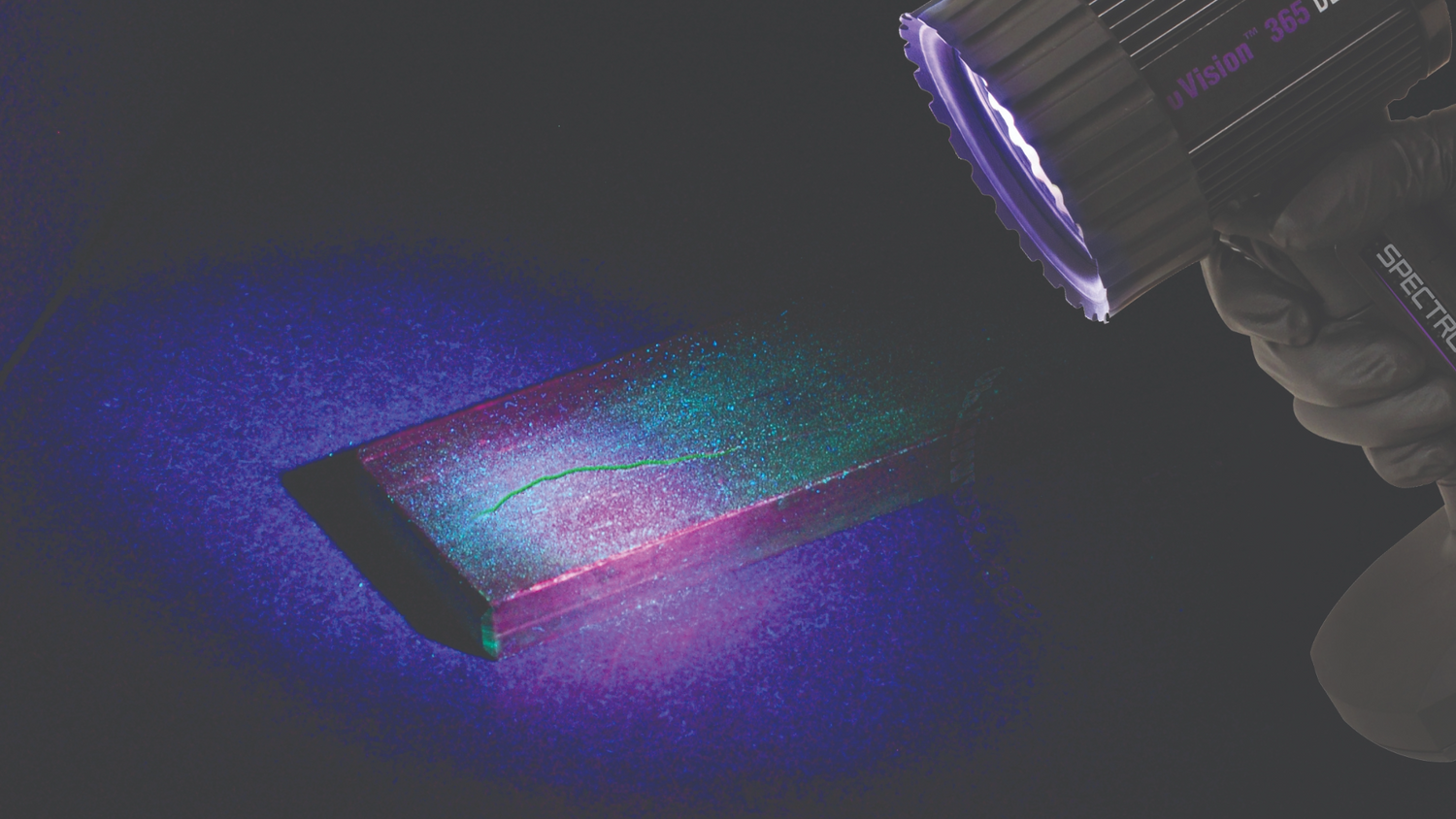
As we start the new year, let's talk about the UV-A inspection mistakes that cost companies time, money, and credibility. In regulated NDT environments, even small lapses in UV-A inspection practices can lead to failed audits, rework or rejected parts. After years in the NDT industry, we've seen these errors repeated across facilities and teams. Here are the top 5 UV-A inspection mistakes we see in the field - and more importantly, how to avoid them.
Mistake #1: Not Verifying UV-A Intensity Before Inspections
Why it happens: Your flashlight powers on, so you assume it’s working properly.
Why it matters: Batteries degrade and UV-A output decreases over time. ASTM E3022 requires a minimum of 1,000 μW/cm² at the inspection surface for a reason.
How to avoid it: Check intensity levels at the start of every shift with a calibrated radiometer. Don't wait until results look questionable or an auditor points out the problem. Make intensity verification part of your standard operating procedure, just like any other quality check.
Mistake #2: Ignoring Battery Life During Critical Inspections
Why it happens: Battery runtime is frequently based on manufacturer estimates under ideal conditions, not real-world inspection use. Teams may also underestimate how quickly batteries degrade over time or assume recharging mid-shift is acceptable.
Why it matters: As battery power declines, UV-A output can become inconsistent, increasing the risk of missed indications. Interrupting inspections to change batteries disrupts focus, workflow and inspection continuity, making results harder to reproduce and defend during audits.
How to avoid it: Know your equipment's actual runtime under working conditions, not just the manufacturer's best-case scenario. If your flashlight can't reliably last a full shift (8-9 hours under typical inspection conditions), you're working with inadequate equipment. Plan your equipment purchases around real-world demands, not just initial cost.
Mistake #3: Using Non-Compliant Equipment
Why it happens: Not all UV-A flashlights are created equal. Many inexpensive options don't meet ASTM E3022, ISO 3059, or OEM-specific requirements like AIRBUS AITM6 or Pratt & Whitney standards.
Why it matters: Using non-compliant equipment can invalidate inspection results entirely. During audits or customer reviews, failure to demonstrate compliance with ASTM, ISO or OEM standards can result in rejected work, liability exposure and loss of customer confidence.
How to avoid it: Verify that your equipment meets all relevant industry standards and customer specifications before putting it into service. Keep compliance documentation readily available and ensure your team understands which standards apply to their specific applications. Don't assume compliance - verify it.
Mistake #4: Neglecting Environmental Protection
Why it happens: Inspection equipment is often selected based on laboratory conditions rather than actual field or production environments. Environmental ratings may be overlooked during procurement or misunderstood as optional rather than essential.
Why it matters: Exposure to dust, moisture or harsh conditions can degrade optical and electronic components, leading to unexpected failures. Equipment downtime during critical inspections causes delays, disrupts production and may compromise safety when replacements are not immediately available on site.
How to avoid it: Choose equipment with appropriate IP ratings for your environment. Look for IP68-rated flashlights that can handle water immersion and complete dust protection - these ratings aren't just marketing terms, they're essential for harsh working conditions. Consider where and how your team works, not just where you wish they worked.
Mistake #5: Neglecting Calibration and Maintenance
Why it happens: Calibration and verification tasks are easy to deprioritize when equipment appears to be functioning normally. UV lamp output degradation is gradual and often goes unnoticed without routine checks, especially in busy inspection environments. Similarly, radiometers may be assumed accurate well beyond their required calibration interval.
Why it matters: Undetected output drift can result in extended periods of out-of-tolerance inspections. By the time an issue is identified, large volumes of inspected parts may be affected, triggering rework, audits and serious questions about inspection validity and traceability.
How to avoid it: Follow ASTM E1417-21 and establish distinct, disciplined schedules for both lamps and radiometers:
UV Lamps: Verify UV-A intensity daily before use. This simple check ensures adequate output at the point of inspection and catches degradation early, before it affects inspection integrity.
Radiometers: Calibrate at least every six months, or more frequently if required by the standard, internal quality procedures or usage severity. Since radiometers serve as your reference instruments, their accuracy dictates every measurement you take; if they drift, every lamp measurement is compromised.
Pro Tip: Document all daily lamp checks, radiometer calibrations and maintenance activities. Implement a tracking system that alerts you before verification or calibration is due, so you're never caught off-guard during an audit or inspection. Don't wait for problems to surface, build compliance into your routine.
The Real Cost of These Mistakes
These aren't just theoretical problems. The consequences are real and measurable:
- Failed audits and compliance issues that can shut down production
- Rejected inspection results requiring expensive rework
- Production delays that cascade through your entire schedule
- Emergency equipment replacement during critical projects
- Damage to your professional reputation and customer relationships
Moving Forward in 2026
Quality UV-A inspection starts with quality equipment and proper procedures. Cutting corners on either one puts your entire operation at risk. As you plan for the year ahead, take time to:
- Review your current inspection procedures
- Verify your equipment meets current standards
- Ensure your team has the training and tools they need
- Establish systems that prevent these common mistakes
At Spectro-UV, we've designed our equipment and services specifically to address these common pitfalls. Our UV flashlights deliver reliable 8+ hour runtime for full-shift inspections, our calibrated radiometers ensure accurate, repeatable intensity verification, and our UV lamps meet ASTM E3022 and international standards with IP68 environmental protection. Beyond equipment, our recalibration services help inspection teams maintain compliance and implement procedures that prevent these mistakes before they happen.
Need help evaluating your current UV-A inspection setup? Contact us at sales@spectro-uv.com or call (866) 230-7305.

发表评论
此站点受 hCaptcha 保护,并且 hCaptcha 隐私政策和服务条款适用。